
SiteHeros Editorial · AI-assisted guide · 3 min read
A useful request process makes the work understandable: what is needed, who owns it, what happens next and how everyone knows it is complete.
Make it easier for clients to ask for what they need
Clients ask for help in the places that feel convenient: an email reply, a quick message or a conversation at the end of a call. As the relationship grows, those small requests become real work. A clear intake process gives them a useful destination and helps your team see the whole picture.
The goal is a smoother experience on both sides. Clients should know where to ask and what information helps. Your team should be able to understand the request without reconstructing it from several conversations.
Begin with the types of requests your business receives most often. A maintenance company might receive visit requests. A creative team might receive content changes. An organization might receive updates to public information. Use the actual work to shape the form and the process.
Collect enough detail to make a good decision
Every field should help someone understand, route or complete the request. A useful starting point is the subject, the affected service or page, the requested change and any relevant deadline or context.
Separate the client’s desired date from the team’s confirmed commitment. That allows someone to explain urgency while your business assesses capacity, dependencies and scope. Clear wording protects the quality of the conversation.
- What needs attention? Give the request a specific subject.
- Where is it? Ask for the relevant page, service or reference.
- What should change? Encourage a concrete description.
- What makes it important? Capture context that helps prioritization.
- Who can answer questions? Make follow-up straightforward.
Keep sensitive information out of general-purpose examples and avoid collecting detail the process does not need. A focused intake is easier for people to complete and easier for your team to use.
Use statuses that tell people something useful
A request list becomes a working tool when its statuses describe what is actually happening. “Received” means the request has arrived. “Needs information” identifies a dependency. “Planned” means the team has made a decision. “Ready for review” gives someone a clear next action.
Choose a small set that matches your delivery process. Assign an owner for the move between stages, and decide who can mark work complete. This creates a practical shared language for the team.
For example, a website content request may need a supplied image before it can proceed. Recording that dependency makes the delay understandable. When the image arrives, the owner can move the work forward without rediscovering why it stopped.
Make completion clear, then learn from the pattern
Completion should mean the agreed work has been checked and the outcome is understandable. Record what changed, note any follow-up and identify who needs to review the result. Use the same care for a small request that you would want a client to experience on a larger project.
Over time, the request history becomes useful evidence. Repeated questions may suggest clearer website content. Frequent changes to the same information may call for a better publishing routine. A recurring handoff problem may reveal a missing owner.
Review these patterns at a realistic cadence. Ask which requests were easy to complete, which needed clarification and which kept returning. The next improvement should come from that evidence, rather than simply adding more fields or statuses.
Build the process around the way your business works
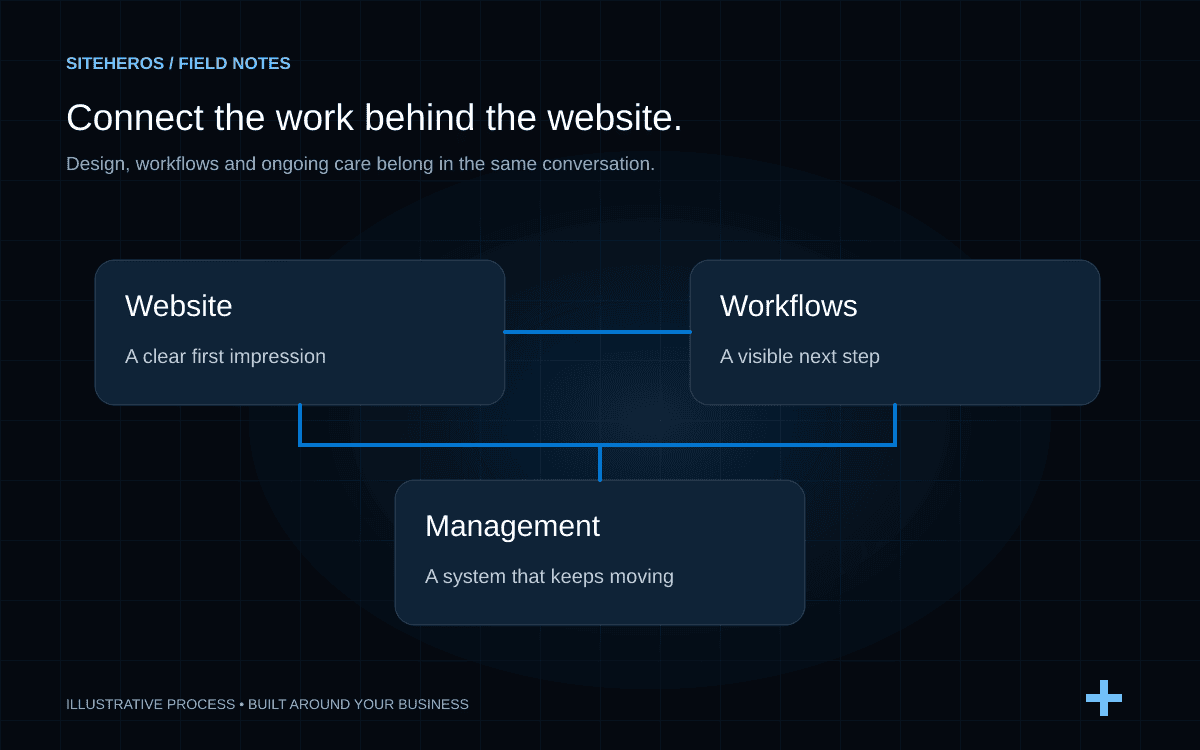
SiteHeros connects website experiences to practical business workflows, so the front door and the work behind it can support each other. Elite Management Growth+ and Scale include a service-request workflow within their agreed scope, with defined capacity and monthly testing of included workflows and entry forms.
That gives the request process a place in an ongoing management plan. The useful conversation is about the kinds of requests you handle, the people responsible for them and the information needed to keep work moving.
To prepare, take five recent requests and map each from arrival to completion. Note where the details were clear, where the owner changed and where somebody had to chase an answer. Those moments show exactly where a thoughtful workflow can make the experience better.